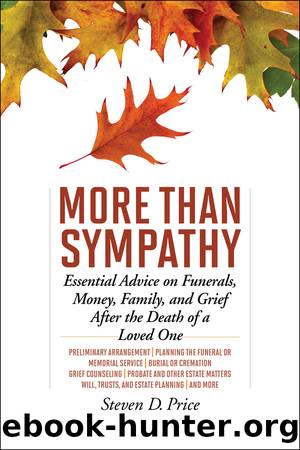
More Than Sympathy by Steven D. Price
Author:Steven D. Price
Language: eng
Format: epub
ISBN: 9781628738889
Publisher: Skyhorse
Published: 2013-12-17T00:00:00+00:00
Dying without having left a Will is called dying âintestate,â pronounced âin-TESS-tateâ and meaning that the property will be distributed according to the laws of the state in which the decedent lived. That doesnât always jibe with what the decedent might have had in mind. For example, although most people assume that a surviving spouse inherits everything, many states say that the spouse inherits only half the estate, with the remainder going to the intestateâs children and other relatives. Stepchildren and nonmarried partners do not inherit under most statesâ laws of intestacy, while the property of a person who dies leaving no heirs goes to the state. Because a Willless estate must still go through probate, the court appoints an Administrator (a female is an Administrix) who handles the details for a fee based on the size of the estate.
The above surveys the usual situation, but there are exceptions. Probate may not be required if an estate is worth less than a certain amount. The amount varies from state to state; for example, California law requires probate for any estate worth more then $100,000.
âSummary probateâ or âsimplified small estateâ proceedings are also available. The requirement in New York State is an estate, excluding real estate and amounts set aside for surviving family members, that has a gross value of up to $20,000. Florida law requires an estate of not more than $75,000 or one that has no real estate and assets of any value that are free from creditorsâ claims except for funeral and certain medical expenses. If so, the courts will authorize property transfer based on only affidavits. But more about that later.
In the event that real estate is located in another state other than where the decedent resided, an ancillary probate will be required before that property can be included in the decedentâs estate.
The involvement of a second state raises the question of âresidence,â an important issue, because residence determines which probate laws will apply. Letâs suppose that the deceased lived in Chicago, but had a little lake house in Wisconsin where he went every weekend and vacation. After his retirement, he spent more and more time at the lake, so much so that people used to joke that he âvisitedâ Chicago. Which law then applies: Illinois or Wisconsin? The answer is based on the decedentâs intention: the state where he voted, where his driverâs license was issued, where he filed state tax returns, where the Will was made, and any other evidence that the person considered himself a resident of one state or the other would be relevant. Some states make the answer easy: Florida requires its residents to live there for six months and a day out of the year . . . and be required to produce proof should the residency be challenged.
Download
This site does not store any files on its server. We only index and link to content provided by other sites. Please contact the content providers to delete copyright contents if any and email us, we'll remove relevant links or contents immediately.
The Brazilian Economy since the Great Financial Crisis of 20072008 by Philip Arestis Carolina Troncoso Baltar & Daniela Magalhães Prates(144697)
International Integration of the Brazilian Economy by Elias C. Grivoyannis(111103)
The Art of Coaching by Elena Aguilar(53293)
Flexible Working by Dale Gemma;(23298)
How to Stop Living Paycheck to Paycheck by Avery Breyer(19741)
The Acquirer's Multiple: How the Billionaire Contrarians of Deep Value Beat the Market by Tobias Carlisle(12338)
Thinking, Fast and Slow by Kahneman Daniel(12333)
The Radium Girls by Kate Moore(12045)
The Art of Thinking Clearly by Rolf Dobelli(10516)
Hit Refresh by Satya Nadella(9146)
The Compound Effect by Darren Hardy(8993)
Tools of Titans by Timothy Ferriss(8420)
Atomic Habits: Tiny Changes, Remarkable Results by James Clear(8358)
Turbulence by E. J. Noyes(8062)
A Court of Wings and Ruin by Sarah J. Maas(7869)
Change Your Questions, Change Your Life by Marilee Adams(7798)
Nudge - Improving Decisions about Health, Wealth, and Happiness by Thaler Sunstein(7717)
How to Be a Bawse: A Guide to Conquering Life by Lilly Singh(7499)
Win Bigly by Scott Adams(7208)
